
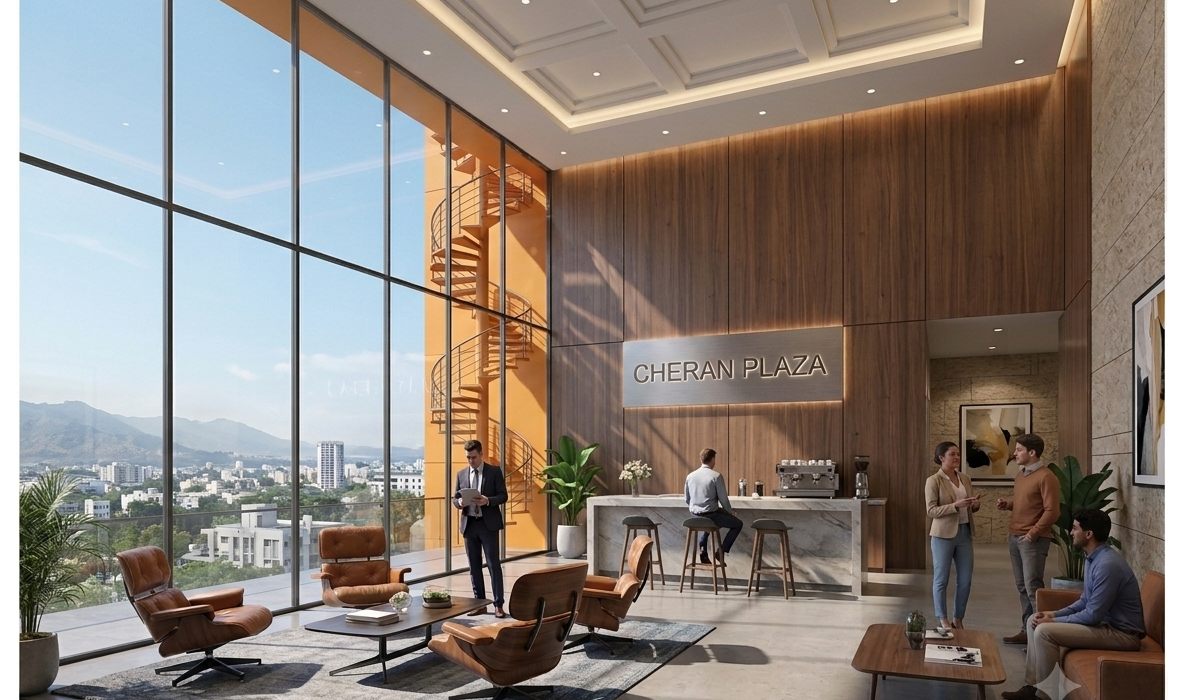
Why Businesses Are Rethinking Workplace Strategy in 2026
The workplace is no longer simply a venue where employees sit at desks from 9 to 5. In 2026, corporate leaders are looking at physical offices through a completely different lens.
Hybrid work patterns, evolving employee expectations, rapid technology adoption, and the growing importance of workplace experience are fundamentally changing how companies plan their commercial real estate footprint.
At the same time, physical offices continue to play an irreplaceable role in driving collaboration, facilitating client interactions, building company culture, and supporting long-term business growth.
Recent research from the CBRE 2026 India Office Occupier Survey found that 77% of surveyed Indian office occupiers expect their office portfolios to expand over the next two years. Additionally, 67% expect flexible workspaces to form a core part of their real estate strategy.
This means forward-thinking companies are no longer asking, “How much office space do we need?” Instead, they are asking: “What should our workplace enable our organization to achieve?”
The Shift: Moving From Headcount to Business Strategy
Traditional office planning was almost exclusively numerical—calculated by dividing overall employee headcount by the number of required desks. Today, leasing a commercial office space in Coimbatore requires evaluating a much broader set of strategic variables.
       [ OLD REAL ESTATE MODEL ]                [ 2026 STRATEGIC MODEL ]
  ├── Headcount ÷ Desks Formula            ├── Dynamic Collaboration Zones
  ├── Fixed Operating Expense              ├── Strategic Business Growth Asset
  ├── Long-Term Rigid Footprint            ├── Core + Flex Adaptive Portfolio
  └── Basic Facility Upkeep                └── Experience & Wellness Centric
To treat real estate as a strategic asset rather than a static overhead cost, modern occupiers analyze:
- Utilization Patterns: How teams interact within the office throughout the workweek.
- Brand Perception: How visiting clients and external partners experience the physical environment.
- Scalability Metrics: Whether the floor plates can absorb rapid team expansion without requiring a physical relocation.
- Transit Friction: How easily employees and executives can access the building from key residential and transit hubs.
- Spatial Efficiency: How effectively every square foot contributes to daily productivity.
8 Key Drivers Reshaping Workplace Strategy in 2026
1. Hybrid Work and Spatial Adaptability
Hybrid work has redefined physical space utilization. Because not every team member requires a dedicated desk five days a week, companies are moving away from rows of identical cubicles.
Instead, modern offices require an intentional mix of private executive suites, open workstations, soundproof phone booths, collaborative project bays, and comfortable team breakout lounges.
2. Elevating the Employee Experience
Salary and compensation packages are no longer the sole criteria for attracting elite talent. The physical work environment directly influences daily job satisfaction, focus, and long-term employee retention.
High-performing employees expect clean architectural lines, ample natural lighting, ergonomic climate controls, and well-maintained common areas. An office should be a destination that employees want to visit rather than an obligation.
3. Designing for Continuous Business Scalability
Choosing an office based strictly on your present headcount is a common operational pitfall. A high-growth enterprise may need to add entire departments, regional teams, or client-facing suites within 12 to 24 months.
Selecting a building with flexible, high-capacity floor plates ensures your organization can expand seamlessly without disrupting ongoing business operations.
4. Strategic Micro-Market Location & Connectivity
A workplace strategy cannot be separated from geographical positioning. An office may feature stunning interior design, but if commuting is frustrating or client access is difficult, the location becomes an operational bottleneck.
Positioning your company along primary arterial routes—such as Trichy Road in Coimbatore—ensures fast access to transit hubs, railway stations, administrative centers, and residential neighborhoods.
| Workplace Metric | Traditional Desk Model | 2026 Strategic Workplace Model |
| Primary Focus | Maximum desk density per sq. ft. | Collaboration, community, and experience |
| Portfolio Structure | Single, long-term rigid lease | Core + Flex hybrid portfolio models |
| Technology Integration | Basic internet and wired desktops | Smart connectivity, AV, and AI-ready infrastructure |
| Site Selection Criteria | Lowest rent per square foot | Transit connectivity, employee commute, & lifestyle perks |
| Environmental Quality | Standard fluorescent lighting | Natural light, scenic views, & sustainable design |
5. The Physical Office as a Collaboration Engine
When routine, individual tasks can be performed remotely, the physical office takes on a distinct purpose: driving human connection.
Employees come together physically for high-value activities—brainstorming sessions, complex project launches, client pitches, leadership alignment, and team mentorship. Modern office layouts must prioritize interaction over isolated desk seating.
6. Integrating Next-Gen Tech and AI Infrastructure
Technology requirements have surged beyond basic Wi-Fi. Corporate occupiers rely heavily on high-speed fiber redundancy, cloud computing, advanced AV conferencing systems, and smart building access controls.
Interestingly, CBRE’s 2026 survey found that while 93% of Indian corporate occupiers are actively implementing AI, 57% report that AI has not materially altered their near-term space footprint. Companies are not replacing physical offices with technology; they are seeking spaces capable of supporting tech-empowered teams.
7. Long-Term Portfolio Flexibility
Flexibility is no longer confined to coworking setups it is now a requirement for enterprise real estate strategies.
By incorporating adaptable commercial floor layouts and flexible leasing arrangements into their core portfolio, companies can pivot quickly during market shifts or organizational restructuring.
8. Commute Infrastructure as a People Strategy
Commute times directly impact workforce fatigue and attendance. In CBRE’s 2026 survey, 70% of respondents identified commute infrastructure as a top priority when selecting office locations.
Choosing a well-connected commercial building reduces travel stress, opens up a broader regional talent pool, and simplifies client visits.
Essential Checklist: What to Look for in a Modern Commercial Space
When evaluating potential commercial real estate in Coimbatore, use this structural checklist to ensure the property meets modern standards:
- Adaptable Floor Plates: High floor-to-ceiling clearance with minimal column obstruction for custom spatial layouts.
- Transit Proximity: Direct connections to primary highways, railway stations, and airport corridors.
- Abundant Natural Light: Extensive perimeter glazing to improve workplace wellness and lower artificial lighting costs.
- Multi-Level Parking: High-capacity covered parking to handle peak morning traffic for employees and visitors.
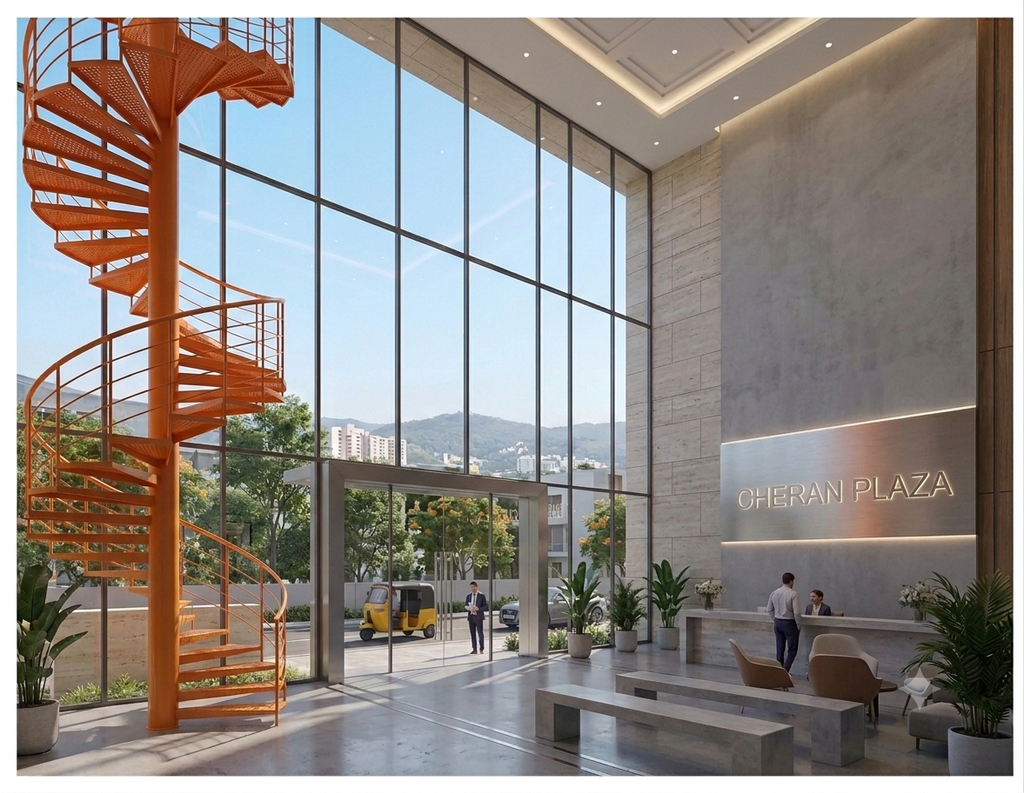
- Professional Common Areas: Double-height reception lobbies, secure elevator banks, and landscaped outdoor spaces.
- Surrounding Amenities: Walking distance to top-tier business hotels, dining options, retail centers, and banking facilities.
Why Building Quality Matters: The Cheran Plaza Advantage
Workplace strategy goes beyond interior design—it depends heavily on the physical building itself. A Grade-A commercial property provides the core structural foundation, power security, and brand prestige that ambitious businesses need.
Situated at 1090 Trichy Road, Cheran Plaza is specifically engineered around these modern workplace requirements. Spanning 10 levels with approximately 10,000 sq. ft. of total leasable space, Cheran Plaza combines structural efficiency with a commanding corporate presence.
“A workplace should actively support the enterprise you are building for tomorrow—not just accommodate the business you operate today.”
With expansive window facades, abundant natural light, panoramic city views, and dedicated multi-level parking accommodating up to 60 vehicles, Cheran Plaza delivers an uncompromised commercial environment.
Its location on Trichy Road places your business minutes away from the Coimbatore Railway Junction, Race Course, and primary arterial connectors to Ukkadam, Singanallur, Gandhipuram, and the Coimbatore International Airport.
To explore how our floor layouts can adapt to your evolving corporate strategy, review our dedicated guide to Cheran Plaza Amenities, discover our strategic address via the Neighborhood Map, or learn more About Us.
Conclusion: Build a Future-Ready Workplace
The workplace of 2026 is adaptable, experience-driven, and tightly aligned with overarching business objectives. As companies reconsider how much space they need and how their teams utilize it, selecting a commercial partner that offers flexibility, accessibility, and high infrastructure standards provides a lasting competitive advantage.
Don’t settle for a rigid, outdated commercial building that limits your company’s potential. Position your enterprise in a space designed for growth.
Transform Your Workspace Strategy
Take the next step in modernizing your corporate footprint. Contact our commercial leasing team at Cheran Plaza today to request detailed floor plans, discuss custom layout options, or schedule a personal site walkthrough.
Frequently Asked Questions (FAQs)
1. Why are businesses changing their workplace strategies in 2026?
Companies are adapting to hybrid work routines, changing employee expectations, rapid technology adoption, and the need for agile, experience-driven offices that support collaboration rather than just desk density.
2. Is physical office space still critical for businesses in 2026?
Yes. While remote work handles independent tasks, physical offices remain essential for company culture, team alignment, complex problem-solving, client presentations, and employee mentorship.
3. How does location on Trichy Road benefit a business’s workplace strategy?
Trichy Road is one of Coimbatore’s premier corporate corridors. It provides fast connectivity to the Coimbatore Railway Junction, major bus terminals, top residential areas, and the international airport, drastically reducing commute friction for employees and clients.
4. What percentage of Indian companies are expanding their office space in 2026?
According to CBRE’s 2026 India Office Occupier Survey, 77% of surveyed corporate occupiers expect their physical office portfolios to expand over the next two years.
5. How does Cheran Plaza support flexible office configurations?
Cheran Plaza offers 100,000 sq. ft. of leasable area across 10 structured levels. Its column-efficient architecture allows enterprise tenants to easily configure custom layouts, including private suites, collaborative open bays, boardrooms, and server facilities.
6. What role does building quality play in employee retention?
High-quality commercial buildings offering natural daylighting, strong climate control, efficient elevators, multi-level parking, and nearby lifestyle amenities create a superior daily work experience, directly improving workforce morale and retention.